AWS vs Google Cloud Comparison: Features, Costs & Best Use Cases
 sds sdsd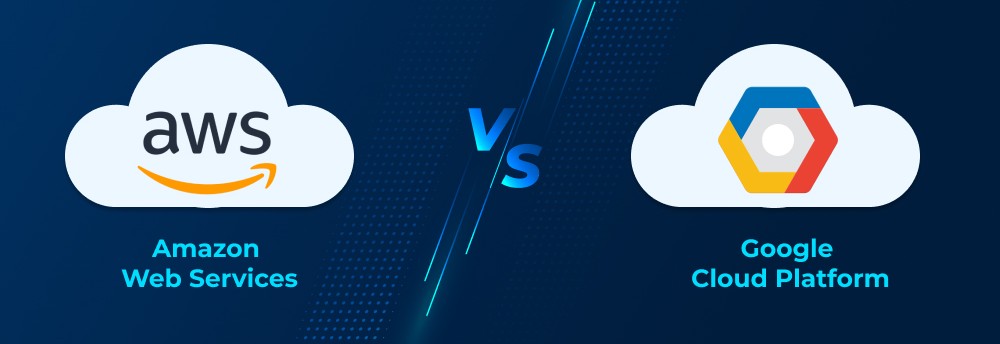
In short,
AWS is the stronger choice for enterprise-scale systems, broad service ecosystems, and organizations that need maximum infrastructure flexibility. Google Cloud is the stronger choice for AI-native products, data-heavy architectures, and Kubernetes-first teams.
The right decision isn’t about which platform is “better.” It’s about which one fits your workload, team, and trajectory.
Before You Read Further
This article is most useful if you’re a startup picking your primary cloud, an engineering team evaluating a migration, or a technical decision-maker scoping a new product line.
It’s less relevant if you’re already deep in the Azure/Microsoft ecosystem, evaluating lightweight hosting platforms like Render or Railway, or looking for managed hosting for simple applications. This is infrastructure-level cloud decision-making, not a beginner’s guide to what cloud computing is.
Talk to our cloud architects for a free infrastructure assessment. We’ll evaluate your application, growth plans, compliance requirements, and projected costs to help you choose the right platform before you commit.
[Schedule a Cloud Strategy Consultation]
AWS vs Google Cloud at a Glance
| Category | AWS | Google Cloud |
| Best For | Enterprise systems, broad ecosystems | AI, data analytics, Kubernetes |
| Core Strength | Service breadth, market maturity | Data-to-AI pipeline, GKE |
| Core Weakness | Complexity at scale | Smaller ecosystem |
| Kubernetes | EKS | GKE (clear advantage) |
| AI Stack | Bedrock + SageMaker | Vertex AI + BigQuery ML |
| Pricing Model | Flexible, complex | Simpler, automatic discounts |
| Learning Curve | Steep | Moderate |
Choose AWS If…

- You’re building enterprise-grade applications with strict compliance requirements
- Your team already has AWS-trained engineers and certifications
- You need access to the widest possible range of managed services
- You’re running complex multi-service architectures with heavy microservices
- You need a global-scale infrastructure with the largest worldwide footprint
- Your organization has existing AWS vendor relationships or committed spend
AWS dominates enterprise adoption for a reason. Its service catalog is genuinely unmatched. It has over 200 services covering virtually every infrastructure use case imaginable. That breadth is also its biggest liability for smaller teams, but for organizations with dedicated platform engineering, it’s an advantage that compounds over time.
The hiring pool is larger, the third-party tooling ecosystem is deeper, and enterprise procurement teams are already familiar with AWS contracts, compliance documentation, and security frameworks. When your buyer’s security team asks which cloud you run on, “AWS” still closes faster than any other answer.
Choose Google Cloud If…
- You’re building an AI-first product where data pipelines feed directly into model training or inference
- Your team runs Kubernetes heavily and wants a managed experience with minimal operational overhead
- You’re a data-heavy startup where BigQuery is central to your analytics stack
- You want simpler, more predictable cloud billing without manually planning reserved capacity
- You’re optimizing for developer velocity over ecosystem depth
- Your team is smaller and can’t afford the cognitive overhead of AWS’s service complexity
GCP’s structural advantage isn’t that it’s newer or cleaner. It’s that the path from raw data to deployed model is genuinely shorter on GCP than anywhere else. For teams where that pipeline is the product, the difference compounds quickly.
Google also runs some of the world’s most demanding infrastructure internally, including Search, YouTube, and Gmail. GCP inherits those engineering decisions in ways that show up in real-world performance and reliability at scale.
Real-World Use Cases
Startups
The right cloud for a startup depends heavily on what you’re building and who you’re selling to. AWS gives you more room to scale in any direction: more services, more regions, and a larger hiring pool when you staff up. GCP gives you faster initial development cycles, especially if your product is data or ML-heavy from day one.
Early-stage startups optimizing for speed and data-driven product development consistently do better on GCP. Startups targeting enterprise customers, however, often benefit from establishing on AWS early.
Procurement teams at large companies have years of AWS familiarity, with existing compliance frameworks, approved vendor relationships, and security review templates. That familiarity quietly shortens sales cycles in ways that are easy to underestimate from the engineering side of the table.
A practical middle ground for many startups: start on GCP for the development speed and AI pipeline advantages, then evaluate whether a migration makes sense before your first major enterprise contract. That’s not ideal, but it’s more common than the “pick one forever” framing suggests.
AI and Machine Learning
This is where the gap between AWS and GCP is most pronounced in 2026, and it’s widening. GCP’s Vertex AI integrates directly with BigQuery, meaning your data ingestion, transformation, and model training environment share the same ecosystem, the same IAM model, and the same billing structure. You’re not moving data between systems to train. It’s already there. The pipeline from raw event data to a deployed model is structurally shorter, which shows up as reduced data engineering overhead and faster iteration cycles.
AWS’s answer, the S3 into SageMaker, is powerful and highly flexible, but it requires more architectural glue, more data movement, and more custom pipeline work to achieve equivalent results. For teams where AI is a bolt-on feature rather than the core product, that flexibility is worth it. For teams where the model is the product, the extra complexity has a real cost.
Foundation model access differs meaningfully, too.
AWS Bedrock gives you a marketplace of third-party models: Anthropic’s Claude, Meta’s Llama, Mistral, and others. These are very strong for enterprises that want model optionality without locking into a single provider’s model layer. Vertex AI integrates tightly with Google’s Gemini models and gives you direct access to TPUs for large-scale training.
GCP’s TPUs are significantly cheaper than GPU-equivalent compute for sustained training workloads, a difference that becomes material when you’re running training jobs at scale regularly rather than occasionally.
In practice, most ML-heavy startups default to GCP because the BigQuery to Vertex AI pipeline eliminates an entire category of data engineering work. That’s not a marketing claim, but an architectural reality that compounds across every sprint.
Kubernetes and Cloud-Native
GKE is the best-managed Kubernetes experience available. Google invented Kubernetes, open-sourced it, and continues to lead its development.
GKE handles node upgrades, autoscaling, and cluster management with meaningfully less operational overhead than EKS in most configurations. Teams running Kubernetes as their primary deployment model consistently report lower maintenance burden and fewer cluster-level incidents on GKE.
EKS makes more sense when Kubernetes is one component of a larger AWS-native architecture. If your workloads are deeply integrated with RDS, ElastiCache, SQS, and API Gateway, keeping Kubernetes on EKS avoids cross-cloud networking complexity and keeps your IAM model unified. The integration story matters as much as the Kubernetes experience itself.
Enterprise and Compliance-Heavy Systems
AWS dominates here without serious competition. Its compliance certification portfolio spans more frameworks than any other cloud provider: SOC 2, HIPAA, FedRAMP, PCI DSS, and dozens more. Regulated industries have years of established AWS architecture patterns, audit documentation, and vendor relationship history to draw on.
For fintech, healthcare, and government contractors, AWS reduces procurement and compliance risk in ways that translate directly into faster approvals and lower legal overhead. GCP is catching up on this dimension, but the gap remains wide enough to matter for organizations where compliance is a primary constraint.
Data Analytics
BigQuery is a genuine competitive moat for GCP. Serverless, fast, and priced per query rather than per provisioned cluster, it also removes the operational burden of managing a data warehouse entirely. You don’t resize clusters, you don’t pay for idle capacity, you just query.
For companies where the data warehouse is central to the product or to internal decision-making, GCP’s data stack delivers faster time-to-insight with less engineering overhead than AWS Redshift. This still requires capacity planning and cluster management even in its serverless configuration.
The Multi-Cloud Reality
Most “AWS vs GCP” decisions eventually become “AWS and GCP” decisions at scale. This is worth planning for early, even when you’re starting on one platform.
Common hybrid patterns in 2026 include running AWS as primary application infrastructure while using BigQuery for analytics, deploying AI and model training workloads on Vertex AI while keeping stateful application backends on AWS, and running GKE for containerized services while relying on AWS RDS for managed databases, where the ecosystem integration matters more than the Kubernetes layer.
Multi-cloud makes sense when your AI workload has genuinely outgrown one provider’s tooling, when regulatory requirements force geographic or vendor diversification, or when the cost arbitrage between platforms is large enough to justify the added complexity. It’s a mistake for early-stage teams. The IAM reconciliation, cross-cloud networking overhead, and split observability stack require dedicated platform engineering capacity to manage well. Start on one, build deliberately, and expand only when the pain of staying single-cloud is concrete and measurable.
Pricing: What Actually Matters
Neither cloud is categorically cheaper. The answer depends entirely on workload shape and how much engineering time you invest in cost optimization.
GCP’s sustained-use discounts apply automatically when you run a VM for more than 25% of a billing month — no manual planning, no upfront commitment, no savings plan architecture required. AWS requires you to proactively purchase savings plans or reserved instances to reach equivalent discounts. For steady, predictable workloads, GCP’s billing is structurally simpler and often lower without any deliberate optimization effort.
AWS is more cost-effective for highly variable or bursty workloads where spot instances, granular reserved capacity tiers, and savings plan flexibility can be aggressively optimized. Its pricing model rewards teams with dedicated FinOps practices and the engineering bandwidth to implement them properly.
Watch these hidden cost areas on AWS specifically: data egress fees accumulate quickly at scale and are easy to undercount in initial architecture estimates, inter-availability-zone traffic is billed and rarely appears in early planning, and managed service markups across a large catalog add up in ways that don’t surface in high-level pricing comparisons. GCP has comparable egress costs but generally simpler pricing structures for core compute and storage that make the total cost easier to forecast.
For startups watching burn rate: GCP’s automatic discounts reduce the cognitive overhead of cost management without requiring a dedicated strategy. For enterprises with FinOps resources already in place, AWS’s flexibility can be optimized into genuine long-term savings, but only if you invest in doing it right.
Still unsure?
Service Comparison: Decision-Relevant Pairs Only
| Workload | AWS | Google Cloud |
| Virtual Machines | EC2 | Compute Engine |
| Managed Kubernetes | EKS | GKE |
| Serverless Functions | Lambda | Cloud Functions |
| Object Storage | S3 | Cloud Storage |
| Managed Relational DB | RDS | Cloud SQL |
| Data Warehouse | Redshift | BigQuery |
| AI/ML Platform | SageMaker + Bedrock | Vertex AI |
| Container Registry | ECR | Artifact Registry |
Decision Matrix
| Your Situation | Best Choice |
| AI-first startup | Google Cloud |
| Enterprise SaaS platform | AWS |
| Kubernetes-heavy architecture | Google Cloud |
| Regulated industry (fintech, healthcare) | AWS |
| Data analytics core product | Google Cloud |
| Multi-service microservices architecture | AWS |
| ML training at scale | Google Cloud |
| Large existing AWS-certified team | AWS |
Final Verdict
AWS is usually the safer choice for organizations that need enterprise-grade infrastructure, extensive service options, and a platform backed by years of operational maturity. If your business operates in heavily regulated industries or already has AWS expertise in-house, it’s often the path of least resistance.
Google Cloud tends to shine when data, AI, and Kubernetes sit at the center of the product. Teams often choose GCP because it helps them move faster, reduce operational overhead, and build modern cloud-native applications without as much infrastructure complexity.
For many organizations, the decision ultimately comes down to one question:
What are you optimizing for over the next two to three years?
- If it’s enterprise scale, compliance, and service breadth, AWS is usually the stronger fit.
- If it’s AI innovation, analytics, and developer velocity, Google Cloud often has the edge.
And if you’re still weighing the options, that’s completely normal. Most cloud decisions involve technical, financial, and organizational factors that don’t fit neatly into a comparison table.
Need expert guidance? Our cloud architects can help you evaluate your requirements and build a cloud strategy that supports your long-term growth.




How We Do it ?
Powering Growth
with Cloud & Automation
Get started in
minutes
Get the latest tech trends, tips & tools
delivered monthly.

 Microsoft Azure
 DevOps
  Software Development
  Staff Augmentation
  React JS
  HTML / CSS / JS
  Website Redesign
  Zoom
Zoom  Bulk Sms
  AIMS
AIMS  AWS vs Google Cloud Comparison: Features, Costs & Best Use Cases
Send a message
We're here to help and answer any questions regarding Zoom you might have. Reach out to us — we'd love to hear from you!